Five of Swords
At a Glance
Upright
- • hollow victory
- • conflict won at cost
- • aggression
Reversed
- • releasing hostility
- • aftermath of conflict
- • consequences arriving
Keywords
Upright
Reversed
Upright Meaning
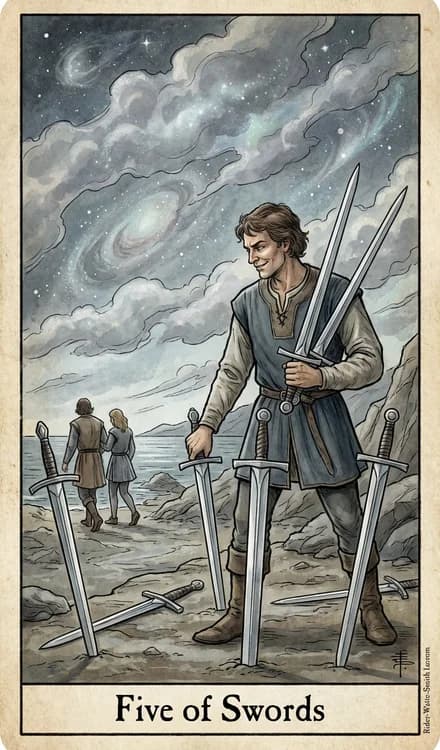
A figure gathers three swords from the ground, grinning, while two others walk away in defeat — one with head bowed in what appears to be weeping. The victor has the swords and the field, but the image has an unmistakably unpleasant quality. The clouds behind are turbulent; the victory itself seems to have cost something not visible on the surface.
The Five of Swords is the card of the pyrrhic victory — winning by methods that leave you with less than you had before. The ego wins the argument but loses the relationship. The negotiator secures the best possible terms but destroys the partnership needed to implement them. The person who needed to be right was right, and now sits alone with three swords and the hollow feeling of an audience that has left.
This card does not assume you are the victor. You may be one of the retreating figures — the person who has sustained real defeat, perhaps unfairly, and who is choosing the dignity of walking away over the humiliation of continued engagement with someone fighting without ethical constraint.
What the Five of Swords asks, in either position, is honest evaluation of cost: was this conflict worth it? What has been gained, and at what price? Sometimes the correct move is to recognize a situation in which all available outcomes involve loss, and to choose the loss that preserves what matters most.
Reversed Meaning
Reversed, the Five of Swords represents either the aftermath of the conflict settling — consequences arriving for the hollow victor, relationships healing after damage was done — or the genuine learning that becomes available when the ego's investment in being right has been released.
This position can also indicate moving past a defeat with genuine processing — not just acceptance but the extraction of whatever genuine insight the loss contained.
The conflict is ending. What does ending it well require?
Symbolism & Imagery
The victor's smirk as he collects the fallen swords is the most telling detail in this card: he is pleased with himself in a way that the two retreating figures clearly cannot share. The sky behind them is genuinely disturbed — torn and turbulent, as if the air element's normally clear quality has been corrupted by the conflict. The water in the distance is choppy and rough. Everything about the environment signals that this victory has not produced the serenity that genuine resolution brings. The number of swords the victor carries — three — leaves neither retreating figure fully defenseless: this is not total annihilation but significant defeat.
Yes/No Energy
The Five of Swords carries a NO — or at minimum a strong caution. The conflict being asked about carries a high probability of damage to all parties regardless of outcome. Reconsider whether engagement is necessary.
Numerology & Correspondences
Five is the number of disruption and the conflict that precedes necessary change. In the Swords suit, Five corresponds to Venus in Aquarius: the planet of harmony and relationship in the detached, intellectual sign, producing the specific dissonance of someone winning a conflict in a way that violates the very values of fairness and dignity they would otherwise claim to hold.
In a Reading
Love
The Five of Swords in love describes a conflict dynamic where someone is fighting to win rather than fighting to understand. Both parties leave feeling worse than before the argument began. The question is whether this pattern is temporary or structural.
Career
In career readings, this card warns against Pyrrhic professional victories — winning an argument at the cost of a colleague's respect, or securing a result through methods that damage your professional reputation in ways that will cost more than the win was worth.
Spiritual
Spiritually, the Five of Swords asks what you are willing to sacrifice to be right about your beliefs. Spiritual humility — the willingness to be wrong, to learn, to yield — is not weakness. It is the condition for genuine insight.
Frequently Asked Questions
What does Five of Swords mean in tarot?
A figure gathers three swords from the ground, grinning, while two others walk away in defeat — one with head bowed in what appears to be weeping. The victor has the swords and the field, but the image has an unmistakably unpleasant quality. The clouds behind are turbulent; the victory itself seems to have cost something not visible on the surface. The Five of Swords is the card of the pyrrhic victory — winning by methods that leave you with less than you had before. The ego wins the argument but loses the relationship. The negotiator secures the best possible terms but destroys the partnership needed to implement them. The person who needed to be right was right, and now sits alone with three swords and the hollow feeling of an audience that has left. This card does not assume you are the victor. You may be one of the retreating figures — the person who has sustained real defeat, perhaps unfairly, and who is choosing the dignity of walking away over the humiliation of continued engagement with someone fighting without ethical constraint. What the Five of Swords asks, in either position, is honest evaluation of cost: was this conflict worth it? What has been gained, and at what price? Sometimes the correct move is to recognize a situation in which all available outcomes involve loss, and to choose the loss that preserves what matters most.
What does Five of Swords mean reversed?
Reversed, the Five of Swords represents either the aftermath of the conflict settling — consequences arriving for the hollow victor, relationships healing after damage was done — or the genuine learning that becomes available when the ego's investment in being right has been released. This position can also indicate moving past a defeat with genuine processing — not just acceptance but the extraction of whatever genuine insight the loss contained. The conflict is ending. What does ending it well require?
Is Five of Swords a yes or no card?
The Five of Swords carries a NO — or at minimum a strong caution. The conflict being asked about carries a high probability of damage to all parties regardless of outcome. Reconsider whether engagement is necessary.
What does Five of Swords mean in a love reading?
The Five of Swords in love describes a conflict dynamic where someone is fighting to win rather than fighting to understand. Both parties leave feeling worse than before the argument began. The question is whether this pattern is temporary or structural.
What does Five of Swords mean for career and work?
In career readings, this card warns against Pyrrhic professional victories — winning an argument at the cost of a colleague's respect, or securing a result through methods that damage your professional reputation in ways that will cost more than the win was worth.