Four of Cups
At a Glance
Upright
- • contemplation
- • apathy
- • missed opportunity
Reversed
- • emerging from withdrawal
- • new opportunity noticed
- • motivation returning
Keywords
Upright
Reversed
Upright Meaning
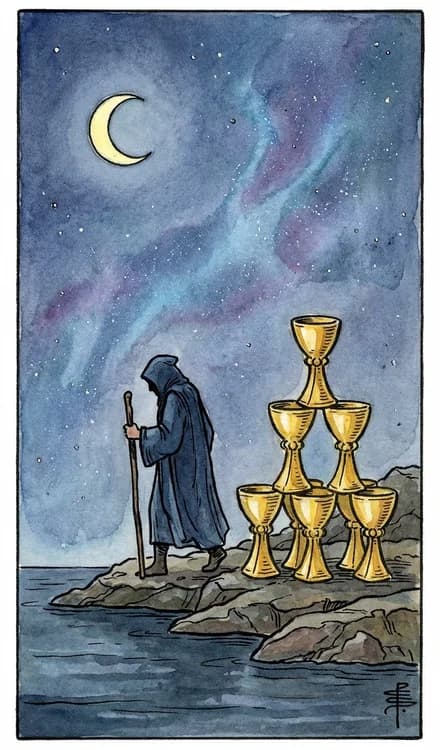
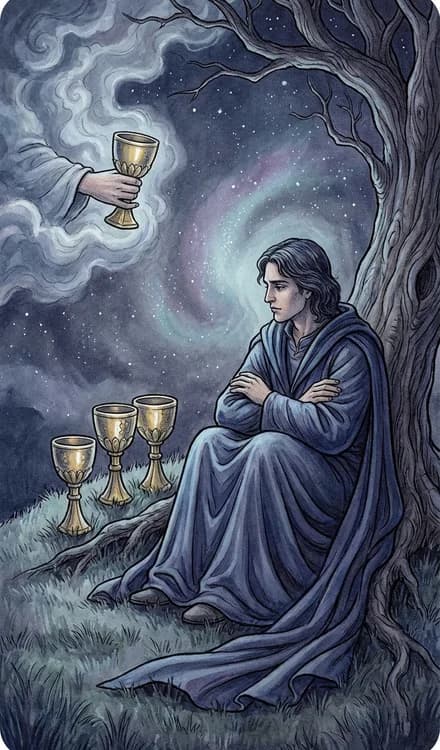
A young man sits beneath a tree with arms folded, staring at three cups on the ground before him. From a cloud beside him, a hand extends a fourth cup — and he does not notice it, or notices it and looks away. The Four of Cups is one of the tarot's most psychologically precise images: the person so absorbed in contemplating what they have or don't have that they cannot see the gift being actively extended to them.
This card captures a specific emotional state: the inward-turning that follows either disappointment or saturation. After the joy of the Three, the Four represents a natural withdrawal — the need to sit with what has been experienced, to process, to evaluate. There is nothing wrong with this inner retreat, and the tree offers genuine shelter.
The problem arises when the contemplation calcifies into a closed posture that makes new offerings invisible. The fourth cup in the cloud is not a consolation prize — it is often something quite good, perhaps exactly what is needed. But in this state of folded-arms introspection, the capacity to receive is temporarily suspended.
When this card appears, ask yourself honestly: what are you looking at so fixedly that you cannot see what else is being offered? Where has legitimate reflection become avoidance of engagement? The cup in the cloud is still being extended. You can still take it.
Reversed Meaning
The reversed Four of Cups signals emergence from withdrawal — a lifting of apathy, the eyes finally opening to what has been patiently waiting. Motivation that seemed gone begins to return. The person who had been turned inward begins to reach outward again toward what life is offering.
This can also indicate a necessary acceptance of what was lost or unavailable — the moment when grieving completes itself and makes room for what is genuinely present. Not every door needs to be open again; sometimes closing one finally allows another to be seen.
Symbolism & Imagery
The figure sits in a Buddha-like cross-legged posture beneath the sheltering canopy of an oak tree — the tree of strength and endurance, suggesting this contemplation is neither shallow nor casual. Three cups arranged before him on the ground represent what is already known, already had, already processed. The fourth cup being offered from the cloud is supernatural — a divine gift requiring no earthly effort to receive, only awareness. The man's folded arms and downward gaze make this refusal — or blindness — complete. The lush green hill and blue sky suggest that the world outside this introspective moment is actually quite fine.
Yes/No Energy
The Four of Cups carries a MAYBE energy leaning toward caution. Something is being offered or available that may not be visible from your current position. The answer may be yes, but you will need to look up to see it.
Numerology & Correspondences
Four is the number of stability and grounding — but in the Cups suit, the stability can become stagnation, the shelter a withdrawal from life. Four of Cups corresponds to Moon in Cancer: the Moon in its home sign, deep in emotional interiority, where the inner world is richer than the outer but where that very richness can create a trap of self-absorption.
In a Reading
Love
In love, the Four of Cups describes the partner who is emotionally unavailable — present but withdrawn, there but unreachable. This may be necessary processing time, but extended, it leaves the other person outside in the cold. What would it take to genuinely re-engage?
Career
The Four of Cups in career readings often appears as professional restlessness — boredom with what has been achieved, indifference to new opportunities that would objectively be good, a feeling of "is this all there is?" A genuine reassessment of values may be required.
Spiritual
Spiritually, this card points to the value and the limitation of prolonged retreat. The inner world has great wisdom to offer, but at some point the practitioner must bring that wisdom back out into the world. Contemplation that never ends is evasion dressed as depth.
Frequently Asked Questions
What does Four of Cups mean in tarot?
A young man sits beneath a tree with arms folded, staring at three cups on the ground before him. From a cloud beside him, a hand extends a fourth cup — and he does not notice it, or notices it and looks away. The Four of Cups is one of the tarot's most psychologically precise images: the person so absorbed in contemplating what they have or don't have that they cannot see the gift being actively extended to them. This card captures a specific emotional state: the inward-turning that follows either disappointment or saturation. After the joy of the Three, the Four represents a natural withdrawal — the need to sit with what has been experienced, to process, to evaluate. There is nothing wrong with this inner retreat, and the tree offers genuine shelter. The problem arises when the contemplation calcifies into a closed posture that makes new offerings invisible. The fourth cup in the cloud is not a consolation prize — it is often something quite good, perhaps exactly what is needed. But in this state of folded-arms introspection, the capacity to receive is temporarily suspended. When this card appears, ask yourself honestly: what are you looking at so fixedly that you cannot see what else is being offered? Where has legitimate reflection become avoidance of engagement? The cup in the cloud is still being extended. You can still take it.
What does Four of Cups mean reversed?
The reversed Four of Cups signals emergence from withdrawal — a lifting of apathy, the eyes finally opening to what has been patiently waiting. Motivation that seemed gone begins to return. The person who had been turned inward begins to reach outward again toward what life is offering. This can also indicate a necessary acceptance of what was lost or unavailable — the moment when grieving completes itself and makes room for what is genuinely present. Not every door needs to be open again; sometimes closing one finally allows another to be seen.
Is Four of Cups a yes or no card?
The Four of Cups carries a MAYBE energy leaning toward caution. Something is being offered or available that may not be visible from your current position. The answer may be yes, but you will need to look up to see it.
What does Four of Cups mean in a love reading?
In love, the Four of Cups describes the partner who is emotionally unavailable — present but withdrawn, there but unreachable. This may be necessary processing time, but extended, it leaves the other person outside in the cold. What would it take to genuinely re-engage?
What does Four of Cups mean for career and work?
The Four of Cups in career readings often appears as professional restlessness — boredom with what has been achieved, indifference to new opportunities that would objectively be good, a feeling of "is this all there is?" A genuine reassessment of values may be required.