King of Swords
At a Glance
Upright
- • intellectual authority
- • clear judgment
- • strategic mastery
Reversed
- • tyranny of intellect
- • cold manipulation
- • abusing authority
Keywords
Upright
Reversed
Upright Meaning
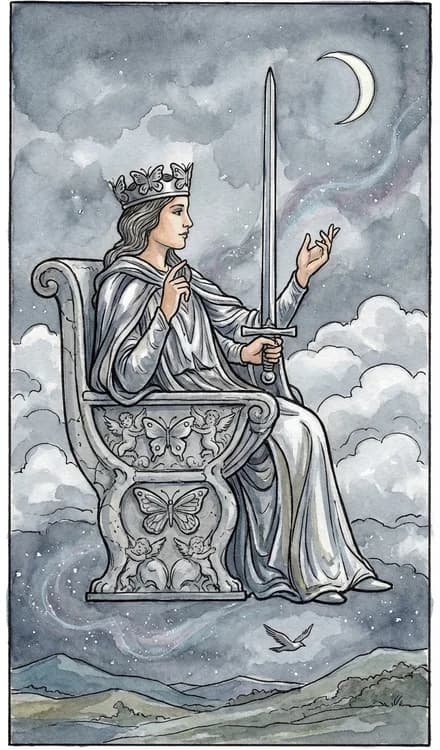
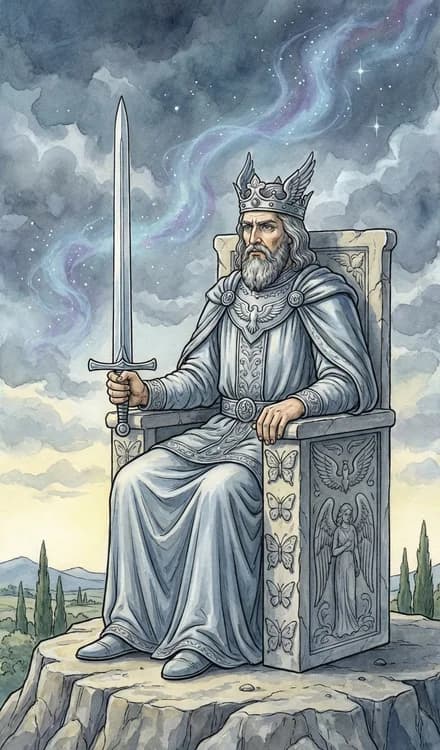
The King of Swords sits fully erect on his throne, sword held straight upward in his right hand, his face turned left — the direction of the past, the direction of reflection. His expression is composed and watchful, bearing the quality of someone who has commanded difficult situations and learned to do so without losing themselves to either emotion or ideology.
The King of Swords is the full maturation of the Air element's intellectual force into genuine authority: the judge who renders difficult verdicts without flinching, the strategist who sees the whole field and directs accordingly, the leader whose clarity of mind produces the conditions for others to think and act more clearly themselves. His authority is neither hot nor cold — it is consistent, grounded in principle, and backed by demonstrated competence.
What distinguishes this King from simple intellectual dominance is the quality of his judgment: he has earned the right to cut through complexity because he has learned to do so without unnecessary damage. The sword points upward — toward principle, toward higher understanding — not at anyone in particular. This is mastery of the mind as a tool for genuine justice and clear leadership, not as an instrument of domination.
When the King of Swords appears, you are being asked to lead from intellectual authority — to bring the full force of your most disciplined, most honest, most strategic thinking to a situation that genuinely requires it. The capacity for this kind of leadership is present. Use it.
Reversed Meaning
Reversed, the King of Swords' intellectual authority becomes intellectual tyranny — the use of analytical superiority to control, diminish, or dismiss others, the weaponizing of logic in service of personal agenda rather than genuine truth, or the cold manipulation of someone who understands people well enough to exploit their patterns.
This position can also indicate dogmatic rigidity — the king who has decided he has all the answers and will not be corrected, whose mind has calcified around its own conclusions.
Intelligence in service of power is not wisdom. Where has the sword become a cudgel?
Symbolism & Imagery
The King's throne is decorated with angels and butterflies — both symbols of transformation and higher understanding. His posture is ramrod-straight, his grip on the sword firm but not white-knuckled. He faces left — backward, toward the history of decisions made — with an expression that suggests he is neither regretful nor disconnected from what those decisions cost. His blue robe is the color of clarity and intellect; his gold crown is authority earned. The clouds behind him are present but not turbulent — the Air element at this level of mastery is not absent but under command.
Yes/No Energy
The King of Swords is a clear and authoritative YES — particularly for matters requiring decisive intellectual leadership, principled judgment, and strategic execution. Act with the full force of your clearest, most principled thinking.
Numerology & Correspondences
Kings carry Fire's directing energy within their suit. The King of Swords is therefore Air directed by Fire: intellectual mastery that has acquired the will and authority to lead, combined with the disciplined use of mental force in service of genuine principle rather than ego. He represents the full maturation of the suit's journey from raw insight to sovereign wisdom.
In a Reading
Love
The King of Swords in love is honest, consistent, and direct — the partner who speaks clearly, judges fairly, and whose intellectual engagement deepens rather than diminishes genuine connection. The challenge is ensuring that directness remains in service of connection rather than becoming the defense that prevents it.
Career
In career readings, the King of Swords represents the highest form of professional intellectual authority: the advisor, analyst, judge, or strategic leader whose clarity of mind and principled judgment has become a genuine asset. This is the destination of the suit's professional journey.
Spiritual
Spiritually, the King of Swords is the theologian, philosopher, and discerning mystic — the one who uses the sharpest intellectual tools not to build a cathedral of theory but to clear the space in which genuine spiritual experience becomes possible. Wisdom, not just knowledge.
Frequently Asked Questions
What does King of Swords mean in tarot?
The King of Swords sits fully erect on his throne, sword held straight upward in his right hand, his face turned left — the direction of the past, the direction of reflection. His expression is composed and watchful, bearing the quality of someone who has commanded difficult situations and learned to do so without losing themselves to either emotion or ideology. The King of Swords is the full maturation of the Air element's intellectual force into genuine authority: the judge who renders difficult verdicts without flinching, the strategist who sees the whole field and directs accordingly, the leader whose clarity of mind produces the conditions for others to think and act more clearly themselves. His authority is neither hot nor cold — it is consistent, grounded in principle, and backed by demonstrated competence. What distinguishes this King from simple intellectual dominance is the quality of his judgment: he has earned the right to cut through complexity because he has learned to do so without unnecessary damage. The sword points upward — toward principle, toward higher understanding — not at anyone in particular. This is mastery of the mind as a tool for genuine justice and clear leadership, not as an instrument of domination. When the King of Swords appears, you are being asked to lead from intellectual authority — to bring the full force of your most disciplined, most honest, most strategic thinking to a situation that genuinely requires it. The capacity for this kind of leadership is present. Use it.
What does King of Swords mean reversed?
Reversed, the King of Swords' intellectual authority becomes intellectual tyranny — the use of analytical superiority to control, diminish, or dismiss others, the weaponizing of logic in service of personal agenda rather than genuine truth, or the cold manipulation of someone who understands people well enough to exploit their patterns. This position can also indicate dogmatic rigidity — the king who has decided he has all the answers and will not be corrected, whose mind has calcified around its own conclusions. Intelligence in service of power is not wisdom. Where has the sword become a cudgel?
Is King of Swords a yes or no card?
The King of Swords is a clear and authoritative YES — particularly for matters requiring decisive intellectual leadership, principled judgment, and strategic execution. Act with the full force of your clearest, most principled thinking.
What does King of Swords mean in a love reading?
The King of Swords in love is honest, consistent, and direct — the partner who speaks clearly, judges fairly, and whose intellectual engagement deepens rather than diminishes genuine connection. The challenge is ensuring that directness remains in service of connection rather than becoming the defense that prevents it.
What does King of Swords mean for career and work?
In career readings, the King of Swords represents the highest form of professional intellectual authority: the advisor, analyst, judge, or strategic leader whose clarity of mind and principled judgment has become a genuine asset. This is the destination of the suit's professional journey.