Nine of Pentacles
At a Glance
Upright
- • material independence
- • self-sufficiency
- • earned abundance
Reversed
- • over-reliance on others
- • ill-gotten gains
- • hollow luxury
Keywords
Upright
Reversed
Upright Meaning
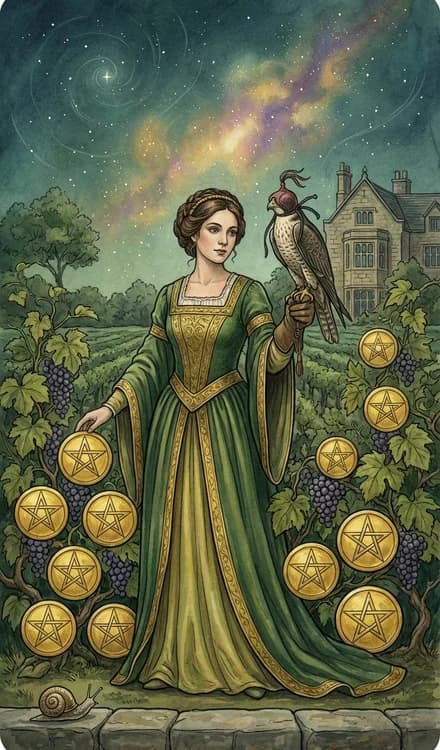
A woman stands alone in a lush garden, one hand resting near a hooded falcon on her wrist, the other touching the vine heavy with grapes and pentacles beside her. She is beautifully dressed, entirely composed, entirely alone in her abundance — and she looks completely satisfied. This is not loneliness; this is genuine self-sufficiency, the specific pleasure of someone who has built something of beauty through sustained effort and can stand within it, sovereign.
The Nine of Pentacles is the card of earned material independence — the abundance that belongs to someone because they built it, cultivated it, and have the skill and discipline to maintain it. This is not inherited wealth or lottery luck but the specific satisfaction of the person who knows exactly how everything in the garden came to be there and what it cost to create it.
The falcon is the most spiritually interesting element: a wild, swift creature that has been trained through patience and skill to perch calmly on the cultivated woman's wrist. She has brought something of the untamed world within the garden's orbit without diminishing it. This is mastery that coexists with respect for what it masters.
This card carries an important message about the value of material autonomy — the capacity to sustain oneself without dependence on circumstances or people that cannot be relied upon. Independence is not isolation; it is the foundation from which genuine, freely-chosen relationship and generosity become possible.
Reversed Meaning
Reversed, the Nine of Pentacles describes abundance that is hollow — luxury that has been purchased at the expense of the genuine satisfaction that makes material comfort actually valuable, or prosperity that depends on others in ways that are not acknowledged or that carry conditions.
This position can also indicate financial dependency that has become untenable, or abundance achieved by means that, on honest examination, the person cannot be proud of.
What would it mean to build something genuinely yours?
Symbolism & Imagery
The garden surrounding the woman is the result of genuine cultivation — every vine, every bloom, every pentacle is there because of sustained effort and care. The yellow robe she wears is the color of the intellect and Sun energy — active, solar abundance rather than passive reception. The hooded falcon represents the wild and the cultivated in harmonious coexistence: the garden tames the world enough to be beautiful without eliminating the wildness that gives it life. The snail at her feet moves slowly through the garden, unhurried — the slow, sure rhythm of genuine Earth abundance.
Yes/No Energy
The Nine of Pentacles is a confident YES — self-sufficiency, earned abundance, and the specific pleasure of material independence are all indicated. What is being asked about is genuinely within reach for someone willing to cultivate it with sustained effort.
Numerology & Correspondences
Nine in the Pentacles suit represents the near-complete material journey — all the work done, the garden beautiful, the harvest rich. It corresponds to Venus in Virgo: the planet of beauty and pleasure in the sign of precision and service, producing the specific aesthetic pleasure of something made beautiful through genuine craftsmanship rather than excess.
In a Reading
Love
The Nine of Pentacles in love speaks to the value of self-sufficiency before partnership — knowing who you are, what you have built, and what you bring to a relationship independent of need. The woman in the garden chooses connection from abundance, not from lack.
Career
In career readings, the Nine of Pentacles is among the most positive indicators for financial independence, entrepreneurial success, and the achievement of genuine professional self-sufficiency. The work has paid off. The garden is yours.
Spiritual
Spiritually, this card celebrates the specific satisfaction of a practice that has been genuinely developed through sustained personal effort — not borrowed from another's spiritual authority but grown in one's own garden, from one's own seed.
Frequently Asked Questions
What does Nine of Pentacles mean in tarot?
A woman stands alone in a lush garden, one hand resting near a hooded falcon on her wrist, the other touching the vine heavy with grapes and pentacles beside her. She is beautifully dressed, entirely composed, entirely alone in her abundance — and she looks completely satisfied. This is not loneliness; this is genuine self-sufficiency, the specific pleasure of someone who has built something of beauty through sustained effort and can stand within it, sovereign. The Nine of Pentacles is the card of earned material independence — the abundance that belongs to someone because they built it, cultivated it, and have the skill and discipline to maintain it. This is not inherited wealth or lottery luck but the specific satisfaction of the person who knows exactly how everything in the garden came to be there and what it cost to create it. The falcon is the most spiritually interesting element: a wild, swift creature that has been trained through patience and skill to perch calmly on the cultivated woman's wrist. She has brought something of the untamed world within the garden's orbit without diminishing it. This is mastery that coexists with respect for what it masters. This card carries an important message about the value of material autonomy — the capacity to sustain oneself without dependence on circumstances or people that cannot be relied upon. Independence is not isolation; it is the foundation from which genuine, freely-chosen relationship and generosity become possible.
What does Nine of Pentacles mean reversed?
Reversed, the Nine of Pentacles describes abundance that is hollow — luxury that has been purchased at the expense of the genuine satisfaction that makes material comfort actually valuable, or prosperity that depends on others in ways that are not acknowledged or that carry conditions. This position can also indicate financial dependency that has become untenable, or abundance achieved by means that, on honest examination, the person cannot be proud of. What would it mean to build something genuinely yours?
Is Nine of Pentacles a yes or no card?
The Nine of Pentacles is a confident YES — self-sufficiency, earned abundance, and the specific pleasure of material independence are all indicated. What is being asked about is genuinely within reach for someone willing to cultivate it with sustained effort.
What does Nine of Pentacles mean in a love reading?
The Nine of Pentacles in love speaks to the value of self-sufficiency before partnership — knowing who you are, what you have built, and what you bring to a relationship independent of need. The woman in the garden chooses connection from abundance, not from lack.
What does Nine of Pentacles mean for career and work?
In career readings, the Nine of Pentacles is among the most positive indicators for financial independence, entrepreneurial success, and the achievement of genuine professional self-sufficiency. The work has paid off. The garden is yours.